
Solid Revolver
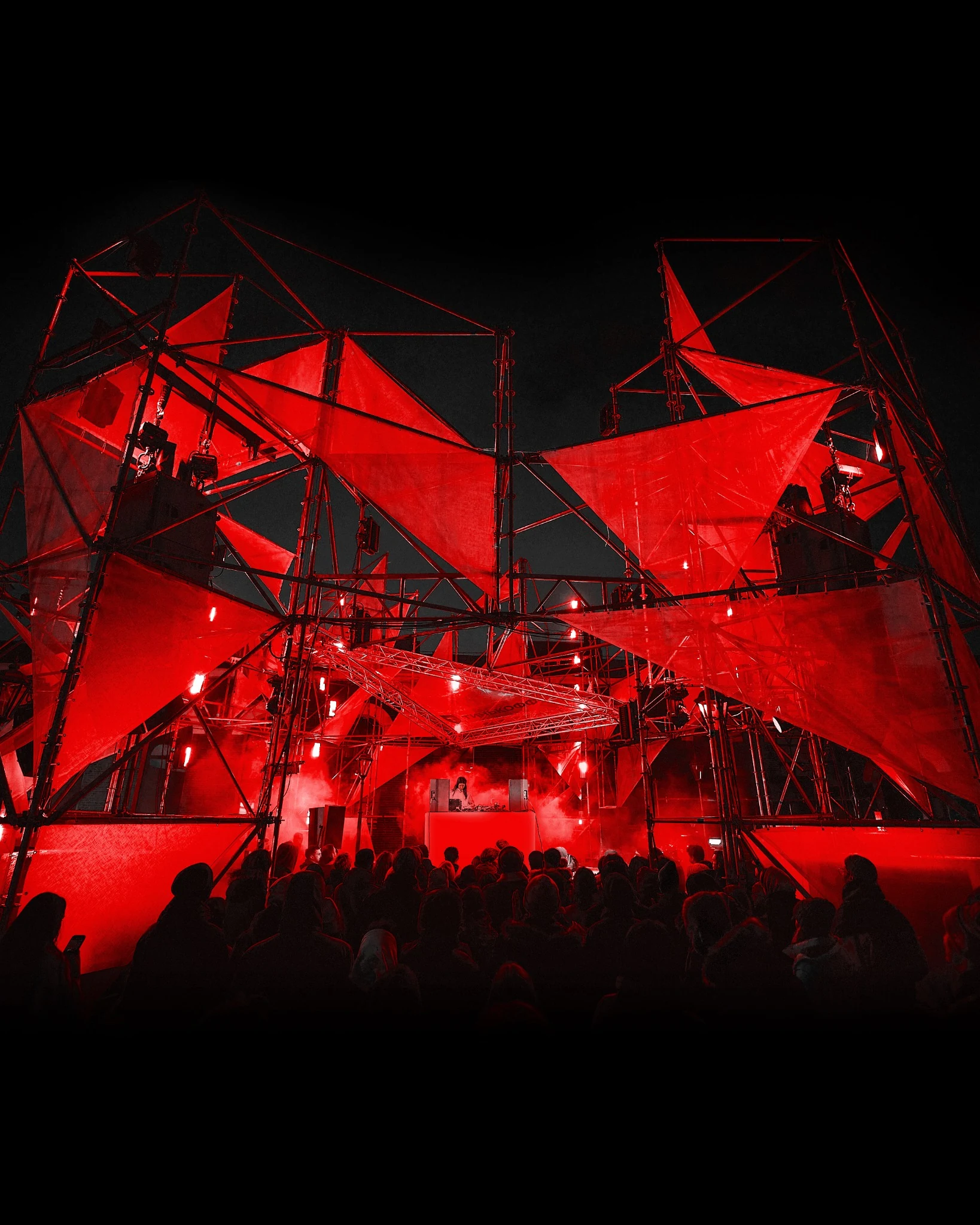
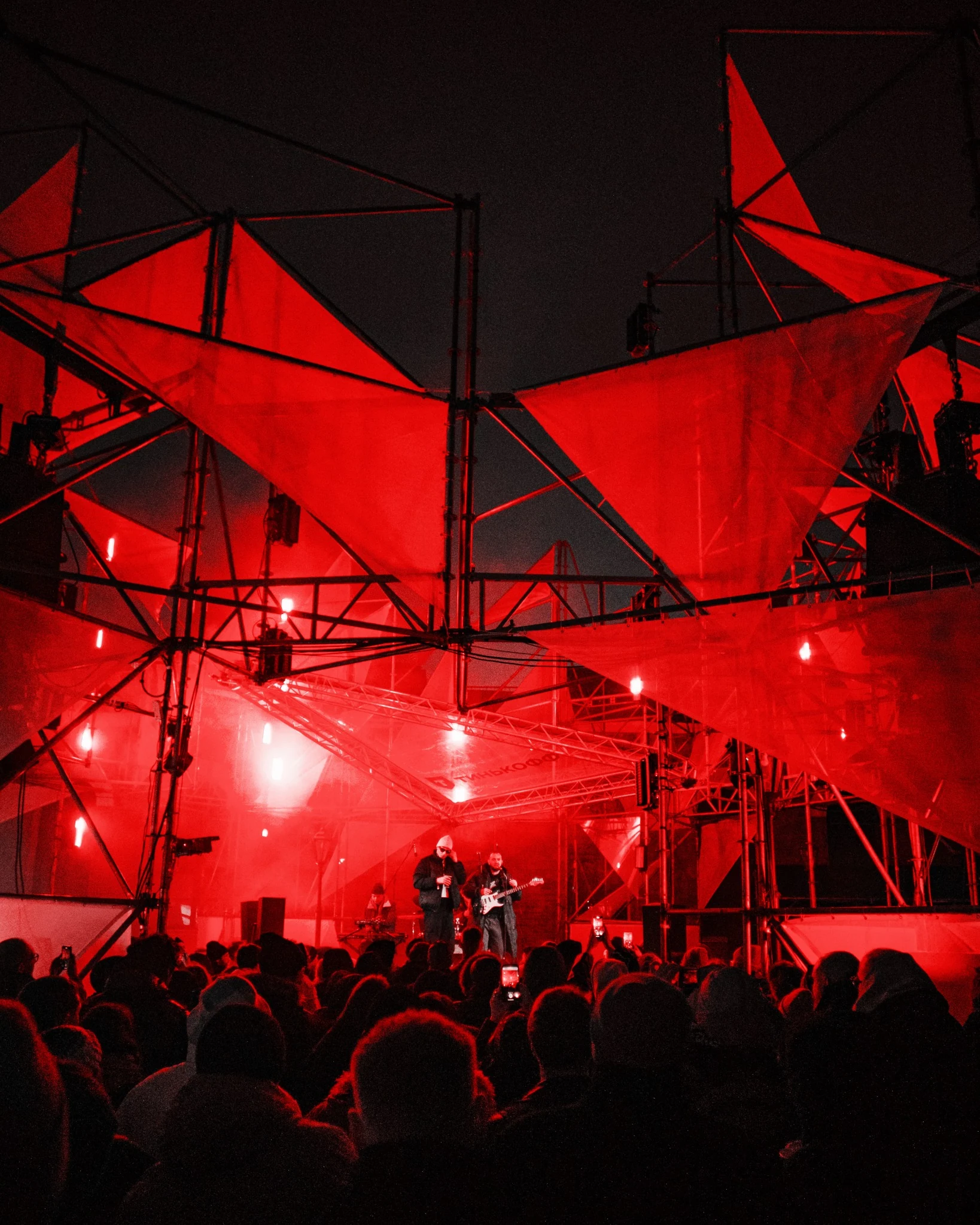
From the car park you could see a crowd inside a red polygon, twenty metres across. People on the far side appeared as shadows. Step through one of the openings and the view reversed: now you were casting a shadow, and what had looked like a solid red wall was a cloud of light turning in smoke. We spent two years developing that idea and six months making Solid Revolver. It stood for two nights in St Petersburg.
Inside the cylinder
Roots United, the team behind Present Perfect, brought the winter edition of Planeta K-30 to Arsenalnaya Embankment on 1–2 March 2024. The programme stretched across six stages at two neighbouring clubs, Blank and Temple of Deer, with 35 artists over the weekend. Our site was outdoors, in the car park between the old brick buildings. People crossing the yard on their way from one club to the other could already see into the work.
The brief meant building something that could hold a concert and still have a life of its own when the stage was empty. We put the musicians inside the work. That left the whole perimeter to design around a person on foot. Someone walking past needed to be able to see what was happening, find a way in, and carry on round the structure once inside.
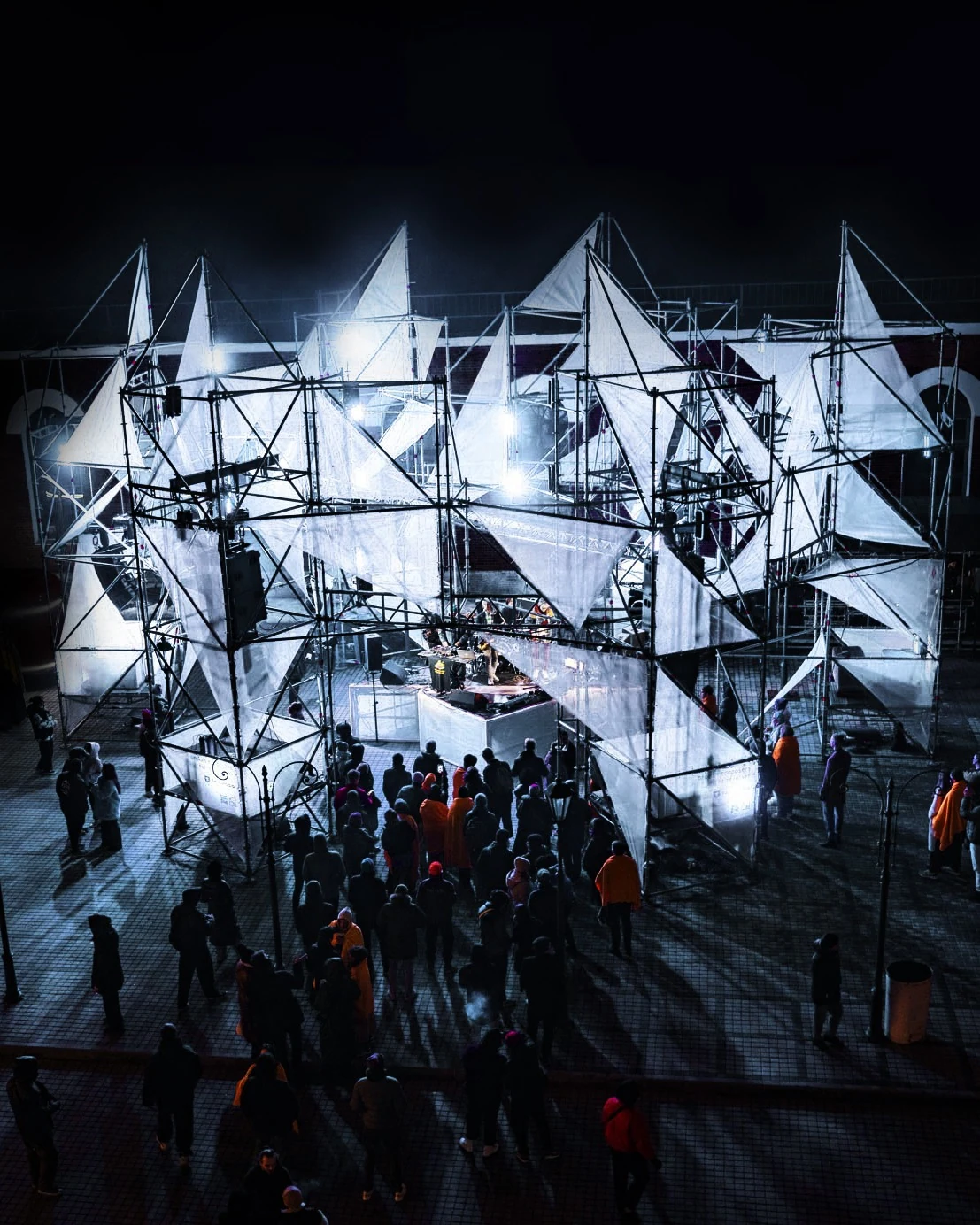
A building made of triangles
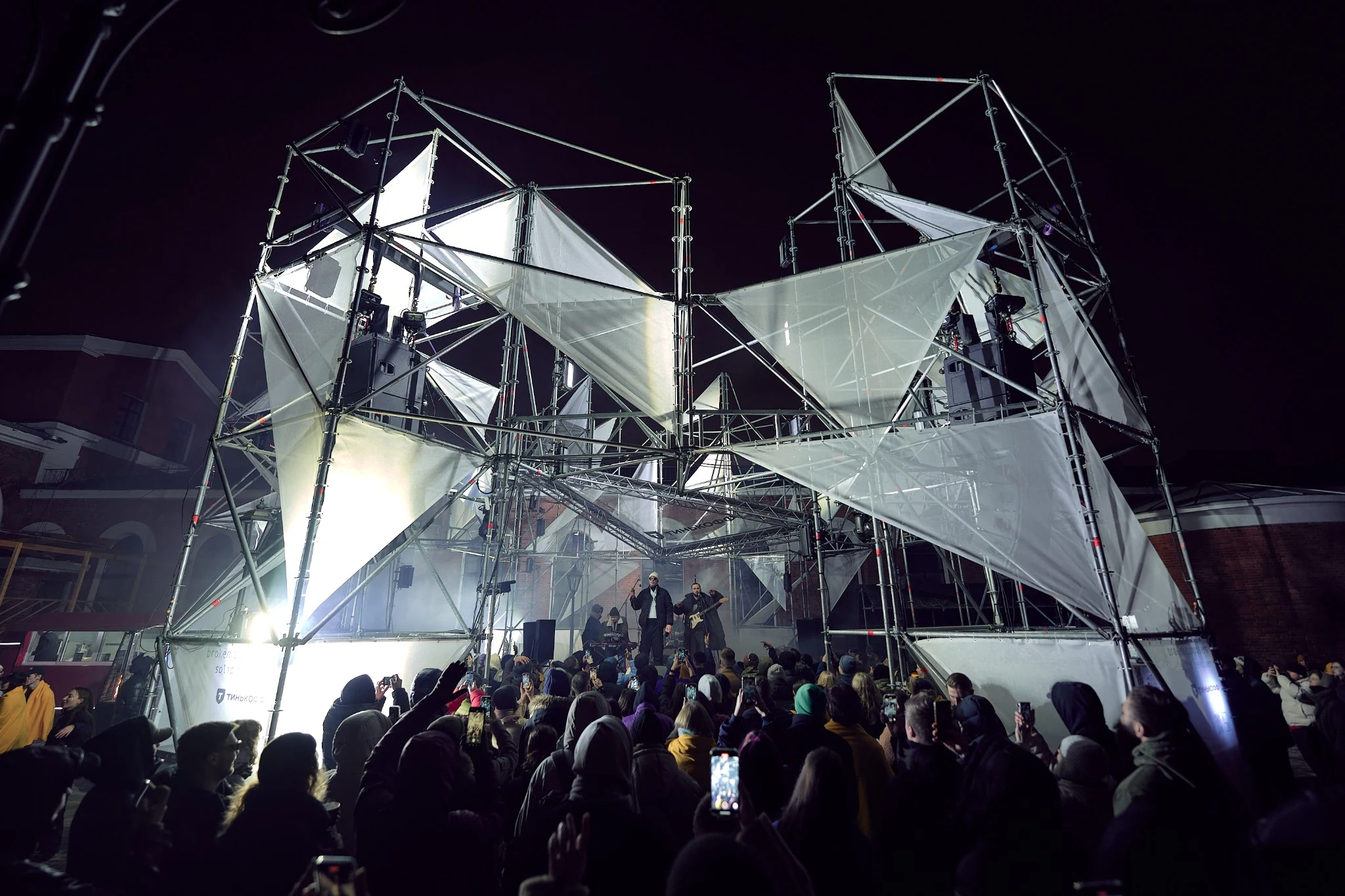
The hardest part to make was the architecture. We had effectively given ourselves a small building to construct. Seen in daylight, its outline was a broken polygon with triangular spikes. The old brick walls were close enough to catch the red and white strobes. At night the light reached across the car park and up those walls, well beyond the footprint of the steel.
The outline was cylindrical, but we built it out of straight sections. Steel uprights and diagonal braces made a series of open bays. We stretched translucent triangular panels across parts of those bays at different heights. In white light you could see the fittings, the loudspeakers behind the fabric and the musicians through a gap. In red, several triangles seen one behind the other could read as a single face. A few steps sideways and it split open again.
Kirill described the movement we were after as a tornado. Its outline should be impossible to hold in your head even though the structure producing it stays in exactly the same place. That difference is easiest to see from the edge, where you can watch the light turn and still see the rigid frame holding it.
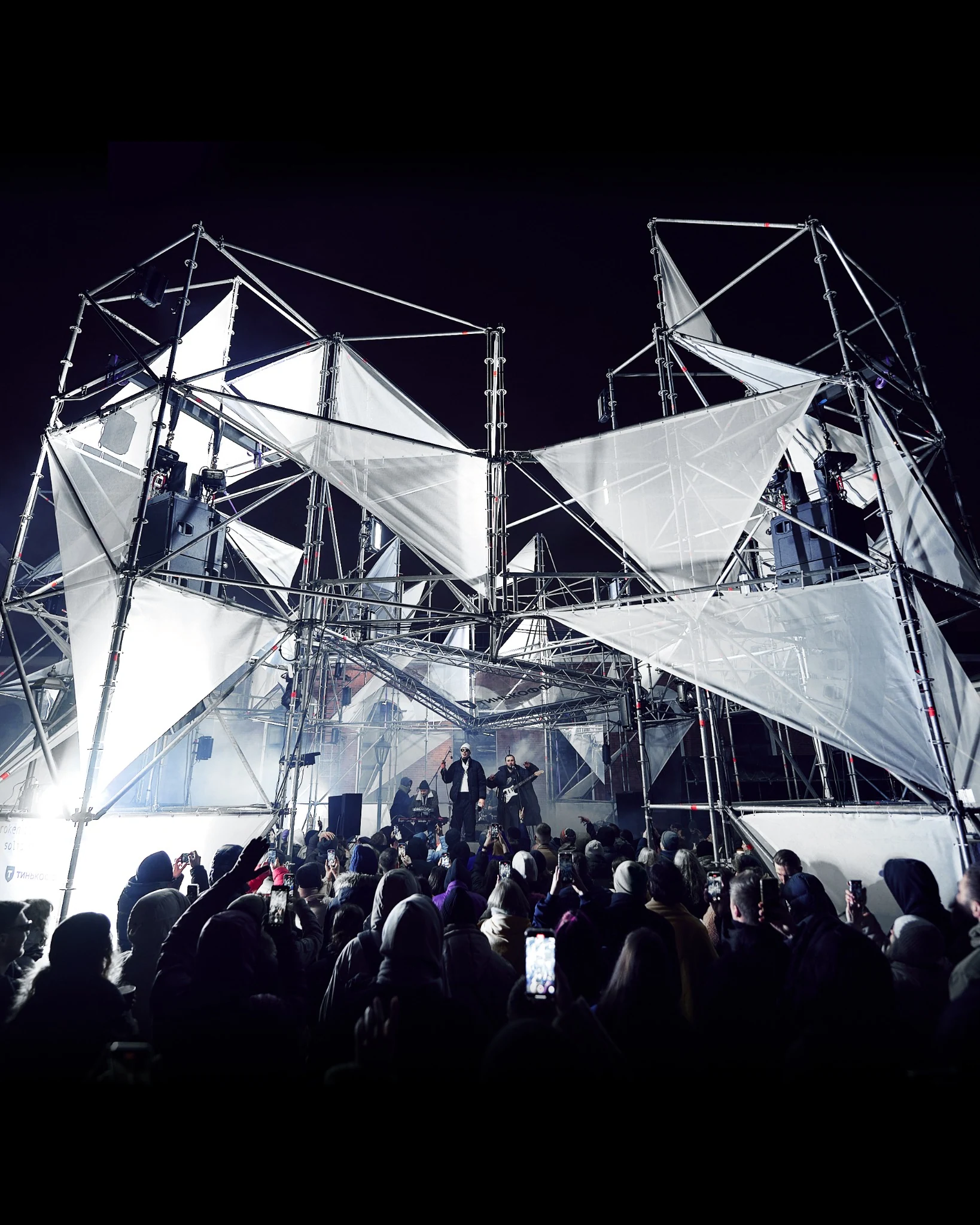
The moving cloud
Smoke makes the moving light visible inside the cylinder. From outside, you see a changing glow and the silhouettes of people within it. Inside, the light crosses the space around you. At the centre it can fill your view; a few steps away, the structure and other people become visible again.
We imagined the light as charged particles caught in the magnetic trap of a collider: always changing shape and direction, but unable to leave the mechanism that holds them. A person entering the cylinder becomes another particle inside that image.
For us, this was also about freedom inside a system. You could keep your own route and rhythm or let yourself become part of the movement around you. We built the space so that this remained a choice, rather than a single position from which everyone had to watch.
A stage without a front row
A rave has a familiar arrangement. The musician takes up a position that everyone else turns to face. For K-30 we kept the musician in the picture and gave people a way to walk all the way around it. The sound had to carry around the stage, including to places with no view of the controls. Someone who lost sight of the musician could stay there for the music.
We presented Solid Revolver at Planeta K-30 in St Petersburg on 1–2 March 2024. The installation also worked as a stage surrounded by the audience. You could pass behind the musician, stay at the edge or move into the light. We wanted people to choose their own place in the show.
Between performances, the installation plays its own light and sound composition. When a guest musician takes the stage, our soundtrack stops and the light responds to their music. The same structure becomes a place for someone else to perform.
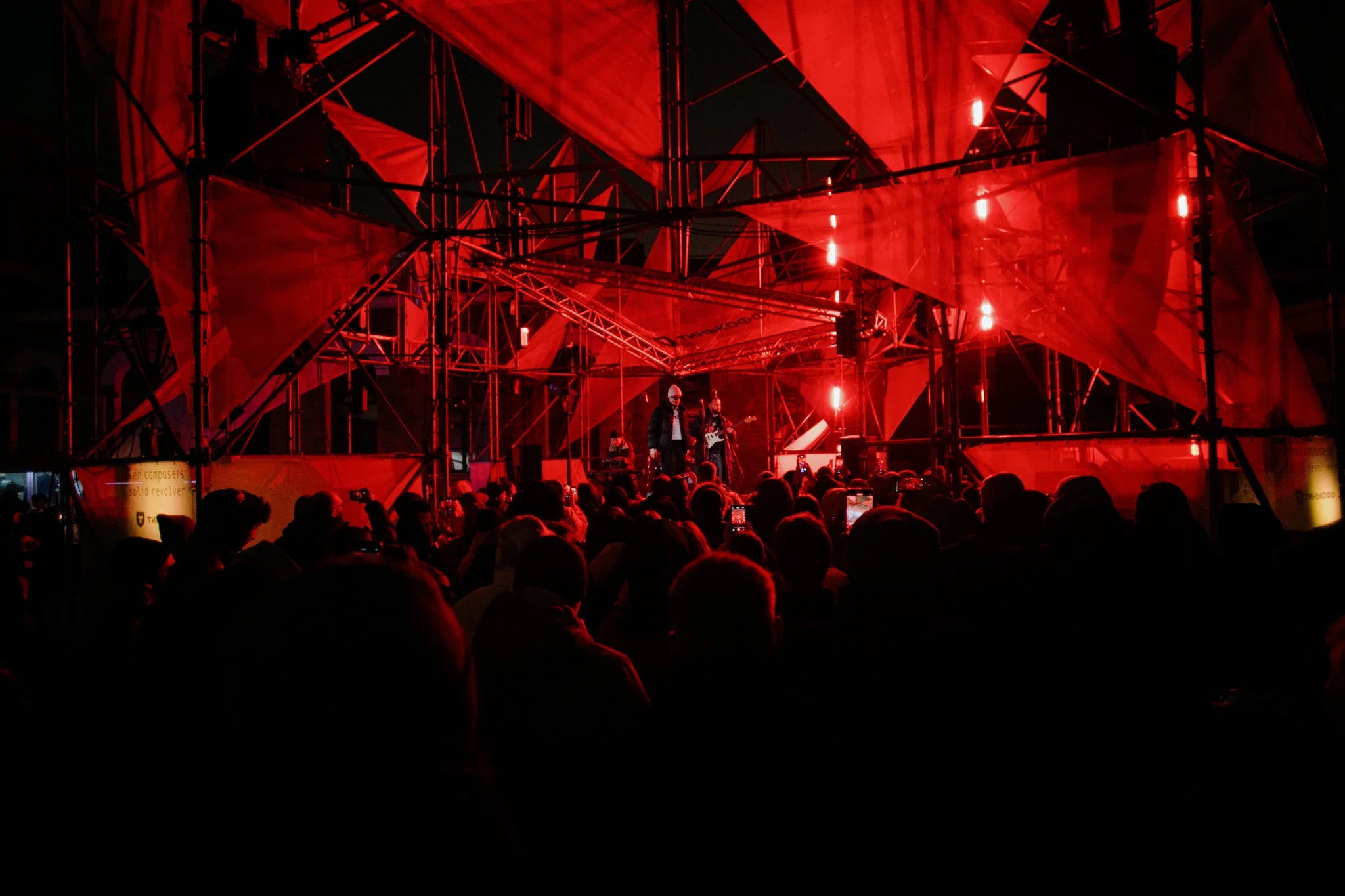
Playing inside the work
We had no arrangement in advance with the guest artists about how their sets should fit our piece. That was part of the interest for us. A musician could pick up on the movement of the structure or play something that seemed to pull against it.
During a concert, someone standing close to the front could watch the singer or guitarist. Farther round, a diagonal of fabric cut across that sightline. From there you could still hear the set and see other listeners through the openings. Two people a short distance apart could follow the same song and see quite different shows.
The sound of metal
One iron pipe striking another was our starting instrument. We put a microphone on the sound and ran the recording through effects. A blow that you recognise immediately as metal can become unexpectedly soft. We wanted to keep both possibilities in the piece, so that the same material you could see supporting the lights could also produce the gentlest sound you heard inside it.
We composed the changes in light alongside the sound. A flash could show the whole frame at once, down to the diagonal braces. As it faded, smoke still caught the light between the panels. Those two images lasted for different lengths of time. That gave us something to phrase against the attack and decay of the metal recordings.
The original single was released on rebenok.music on 29 February 2024. The longer installation version followed on Bandcamp on 28 June 2025.
The installation came down after the festival. The track, its cover, the photographs and the music video are what people can encounter now. In the car park there was one thing none of those could decide for you: where to stand when the light turned.
Films
Broken Composers / Kirill Rave and Vitali Yu. Presented at Planeta K-30 by Roots United, with support from Tinkoff.
