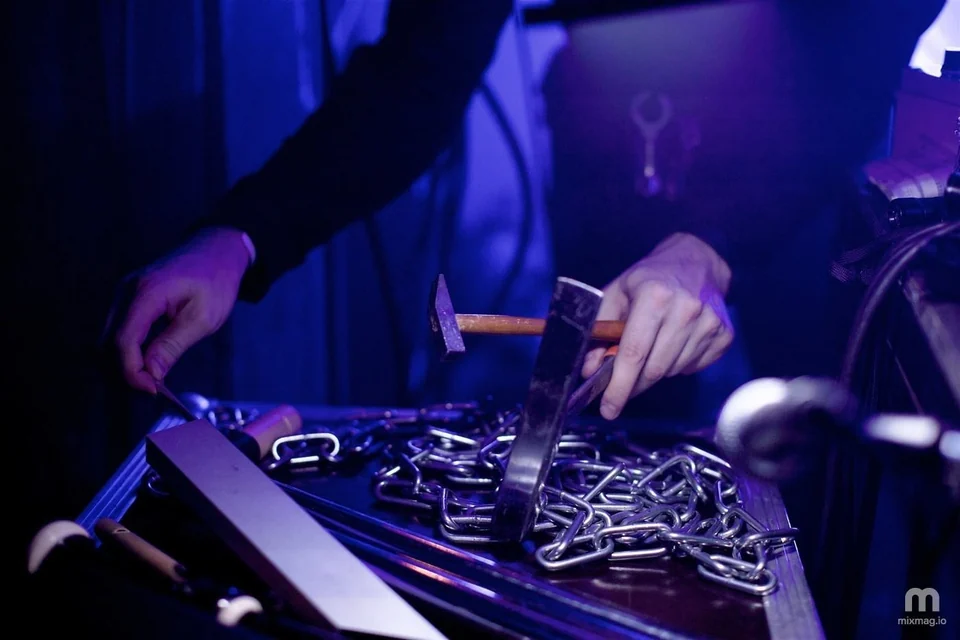
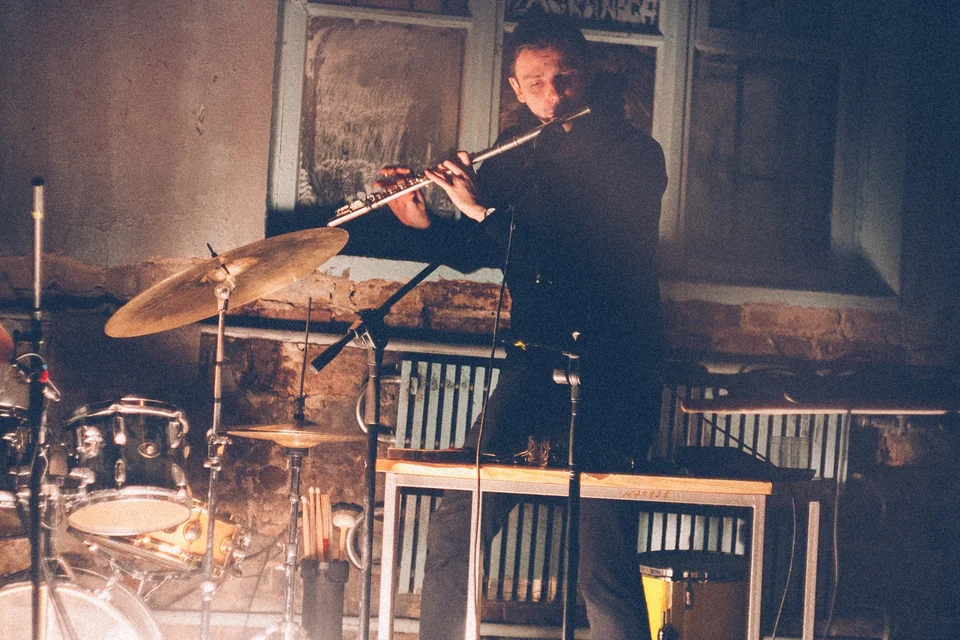
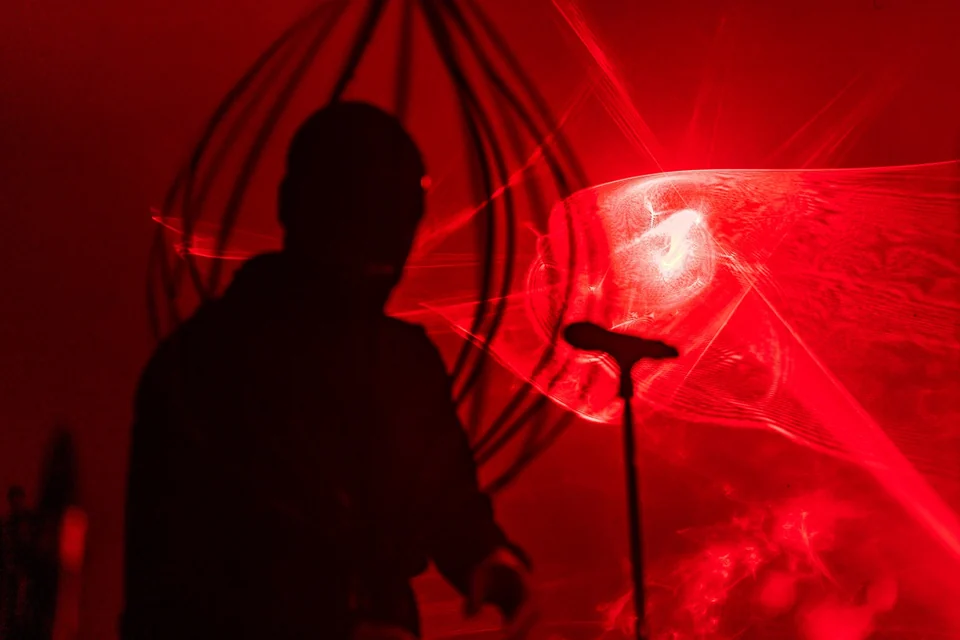
Kirill puts down the chain and reaches for his flute. You can see that both his hands are busy with the flute, but you can still hear the chain. Vitali has its last rattle in the electronics. He can keep it going under the first breath of the flute, cut a beat out of it, or let the metal die away until the breath is all that’s left. A lot of our music happens in that handover.
We play the light live too. One of us can spread a narrow optical image across a whole ceiling while the other holds a single sound. In a club you might hear the change before you look up. In a theatre you might see a dancer step into the light before you hear the next phrase. Where the audience is standing matters enough that we start working on a set by walking through the venue.
Choosing the space
We walk the route from the entrance to the instruments. One of us takes the audience’s position while the other comes in. Can you see the hands? Can you see a figure cross the room before it reaches the table? At the Alexandrinsky Theatre we had the lobby and the hall as well as the New Stage. People encountered the projections on the way to their seats. The first image of the show could happen before either of us played a note.
At Ääniwalli in Helsinki the available surface was a courtyard façade. A line crossing it would disappear at a window and pick up again on the brick. At Signal in Nikola-Lenivets we suspended an inflatable dome over the instruments. From the crowd you could see our bodies at the bottom of the image and look up into a much larger shape. Those two spaces called for different movements of the optics. A small turn that carried an image over the lip of the dome would take it off a wall altogether.
Ääniwalli, Helsinki. The projection crosses the windows above the crowd.Signal, Nikola-Lenivets. The dome is visible from across the crowd.
Acoustic instruments and electronics
At Neptune in Moscow our percussion fitted into a tray. A single metal piece gives you a sharp attack and a little tail. Draw a length of chain across the other pieces and you get a run of uneven attacks. Raise the chain and let the links fall one after another, and you can play the spacing between the hits with your wrist. A close microphone lets someone at the back hear a small movement like that.
At Werk in Kazan we put a chain and a crystal bowl on the same table. The bowl carries a note after the hand moves away. The chain gives us a cluster of short sounds to set against it. At Monowave we used a crystal glass. At the opening of Kirill’s Celestial Structures exhibition in Finland we brought files, chisels and recorders. Some of our string instruments we build ourselves. We choose objects by what we can do with them in the middle of a phrase: strike, drag, blow, damp a note, or leave it ringing while we pick up something else.
Neptune, Moscow. The percussion fits in a single tray.
The microphone gives the two of us different access to the same gesture. Kirill can change the next impact at its source. Vitali can work on the sound of the previous one while it is still coming through the effects. A few links of chain can supply a pulse long after the hand has stopped moving. With a flute over it you can follow both time scales at once, the length of a breath and the short repeated hit.
At the second ARTLihoradka at Squat 3/4 the power went out. We still had the transverse flute and the metal percussion, so we carried on. For a while the audience heard the acoustic part alone. Ordinarily the microphones let those same little sounds fill a club.
Zagranica, Moscow. Moving from the percussion to the flute.
Playing the projection
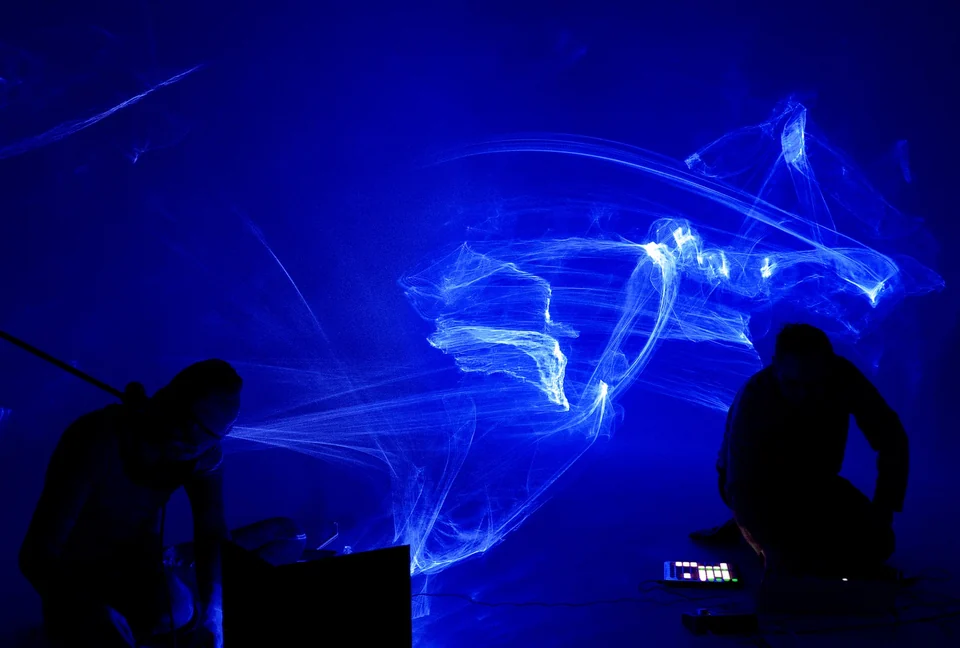
Kirill developed the Laser Lumia optics that we operate on stage. A laser passes through rotating glass. We turn prisms and mirrors, change the angle and shift the focus by hand. There is a big difference between turning slowly enough to follow one fold in the image and moving far enough for the whole pattern to open out. Smoke lets you see the light on its way to the projection surface. From inside the room the path of the beam and the image it lands on are both visible.
We listen while we make those changes. A sustained sound leaves room for the light to move. A dense rhythm can carry on underneath a nearly still image. When we bring the two movements together after that, the change is audible as well as visible. This is why the person operating the optics is playing the set alongside the person on electronics.
Lumia at Signal. The musicians are visible below the folds of the projection.
At ArchiLoft a performer held a small glowing sphere close to a spiked mask. At face height you could see the outline of the spikes. Lower down, the same sphere picked out the hands and folds of fabric. The performer could change what the audience saw just by changing the distance between hand and face. The costume gave that movement something to reveal.
ArchiLoft, Moscow. The sphere lights the performer and the person reaching towards it.
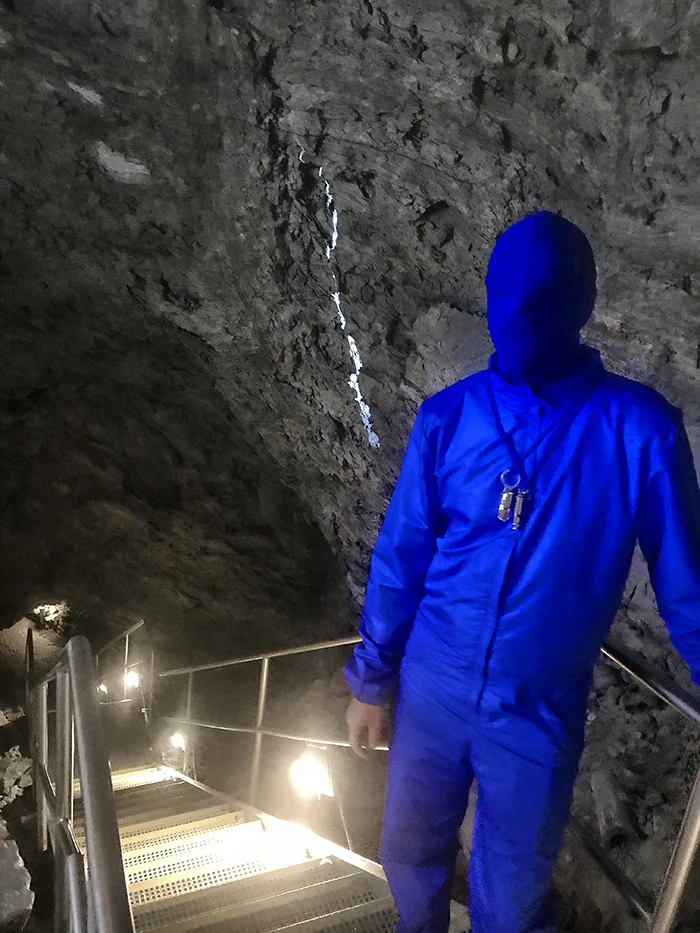
We try a costume both at the instruments and at audience distance. A headpiece needs to read against the projection from the back of the room. At the table Kirill still needs to reach the percussion and bring a flute to his mouth. In Barbarossa Cave the blue costume covered the whole figure, with metal objects hanging from it. On the stone staircase the outline of the body was visible well before anyone could make out a face.
Anhydrite Biennale. A blue figure on the steps of Barbarossa Cave.
At Slwdnc × Yoyaku in Moscow we used signal flags. The performer could take up a position between the projection and the instrument table and change the shape of the shadow by raising a flag. In Chaos Sq. we had the depth of a theatre stage and dancers who could cross a plane of light. The entrance, the angle of the body and the next sound all belonged to the same scene.
Slwdnc × Yoyaku, Moscow. The raised flag cuts into the red light.
Performance formats
Lumia Live
In a slower electroacoustic set there is time to follow a single sound from the first strike to its last vibration. We play inside the light installation. During lockdown we set up at Qweex for Resonance Moscow and improvised for the cameras, bringing the instruments and the projection into the same studio frame.
Lumia Rave
A kick can keep the room moving while Kirill changes instruments or turns to the optics. We can bring the percussion back across that pulse and let the optical image take a longer phrase. A lighting artist joins us for the club shows.
Chaos
The dancers have their own entrances and positions relative to the light. We compose passages in which the stage picture comes together, breaks apart and forms again. The Alexandrinsky performance below shows how far a single shadow can travel across the stage.
Phygital Live
One of us is physically present in costume, playing the acoustic sources and operating the optics. The other plays the electronics remotely. Their face and figure are projected into the venue and change with the rhythm. The exchange between the two players continues across two locations.
Selected performances
Chaos Sq. ↗· Alexandrinsky Theatre. A dancer crosses a red plane of light on the New Stage.
Lumia / Signal Festival ↗Nikola-Lenivets · 2019. Music and optical projection under an inflatable dome in Nikola-Lenivets.Lumia / Modul ↗Moscow · 2019. Our audiovisual set for the Ultimae Records night in Moscow.Resonance 231 ↗Megapolis 89.5 FM · 2020. The studio session filmed for Nikita Zabelin’s radio programme.NUR / Werk ↗Kazan · 2021. Crystal bowl, chains and electronics at the Kazan night showcase.Slwdnc × Yoyaku ↗Mutabor, Moscow · 2020. Signal flags and their shadows above the instrument table.Ääniwalli ↗Helsinki · 2018. Blue light travels across the walls of a courtyard.
Live · Broken Composers | Site-Specific Audiovisual Performance