Most of our tracks start in the middle of an improvisation. One of us plays something and the other picks it up. If there’s a bit we both want to hear again, we come back to it at rehearsal. Once we’ve made a track out of it, we take it on stage and pull it apart again.
At a rave we can stay with the kick for as long as people keep dancing. When we write for an installation, we have to allow for someone walking in halfway through the music.
One of us makes sounds with voice and percussion; the other turns them into track elements in Ableton Live. That is how we made reAct. We stretch recordings, change their pitch and compress them, pushing ordinary tools far beyond their usual settings.
The roughness comes from that process. A voice or a struck object loses its familiar shape, but the unevenness of playing it stays in the music. Distorted vocals and acid sounds build towards the track’s frantic ending. The equipment is simple. What interests us is how far we can take the sound.
TSYGUN play aluminium guitars and radiate full analogue metal insanity. We are the same breed, just laser-cut and digital. Boloto brought us together: their sound meets our electronic processing in this remix.
What we like about TSYGUN is that combination of precision and insanity. They are an absolutely precise metal unit, and we wanted to work with that sound through the tools we use ourselves. Their analogue metal and our digital processing meet in the same track. Boloto is the result of that collaboration. A proper ass-kicking collab.
We took radio-signal material and turned it into sound, then worked with wavetable and FM synthesis to make four pieces. What interested us was the movement between pulses and irregular bursts: a rhythm appears, then noise interrupts it.
That behaviour became the basis of both the music and the PSR J1032–5804 installation. In the sound, it produces sharp textures, glitches and changes of rhythm. In the sculpture, it becomes spikes and hanging elements; on the screens, images twitch with the bass and melodies. We wanted the music and the object to come from the same material.
We recorded metal hitting metal and tried to find tenderness in that noise. Those recordings became the music for Solid Revolver, a rotating cloud of light inside a twenty-metre cylinder.
We wanted to hear something in the material that was not obvious from the first strike. Processing the recordings let us work towards that tenderness, while the starting point remained a physical collision. In the installation, the music plays with the turning cloud of light.
There are two versions: the original single and the longer installation version available on Bandcamp.
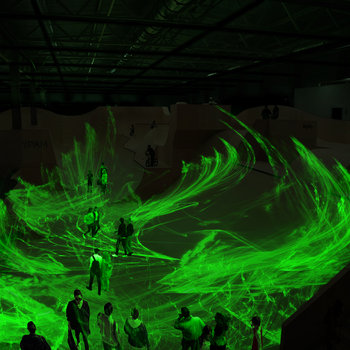
We wrote two pieces for a valley people could walk through barefoot. Laser Meadows turned an indoor BMX park into a meadow of light. One piece is built around piano; the other starts with a hammer striking a string, whose vibration becomes synthesis.
We wanted something romantic for this meadow, done in our own way. The music speeds up and slows down, with references to John Cage. Recordings of birds and insects pass through our processing system until they become psychedelic. Both pieces are here: Laser Meadows Angle and Laser Meadows Curve.
Towers of light rise, build themselves, fall apart and begin again. We wrote these four pieces for that sequence in Tetrahedron, presented among the Admiralty ruins at Noch Sveta in Gatchina.
The work is an homage to Ryoji Ikeda, an artist who has influenced us, and his spectra series. We took the idea of light reaching into the sky and imagined a structure that could keep being built and destroyed. The music develops with it, through the appearance and collapse of these temporary towers. The four pieces can also be heard here away from the installation.
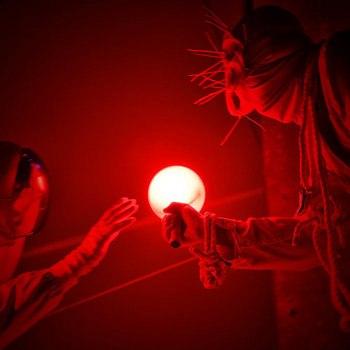
A red circle hangs in a circular courtyard. Then the bass comes in and the circle breaks apart. We wrote Aftercolour for that change, when a simple, calm image suddenly stops holding together and becomes fragments of light.
The installation was made for the courtyard of the Repin Academy of Arts in St Petersburg, as a tribute to Malevich and Suprematism. Sound is part of what happens to the circle: the arrival of the bass accompanies its breakup. The music and the light share that transition from a complete shape to fragments. This is the music from that work.
I was playing the keys and Kirill was blowing a whistle. We were rehearsing, improvising together, and recorded Xorosho in one take. The track is that live recording: two people playing in a room and finding out where the music will go as they go along.
Its changes came from playing together. We did not need another take to turn that rehearsal into a track. Xorosho also became part of False Techno, an album we made while looking for more freedom in the way we play and build tracks. Here, that freedom came through the keys, the whistle and the course of the improvisation.
One track accelerates from 20 to 200 BPM. Another is made entirely from a trowel striking a radiator. A third contains eighteen tunes. We made this album while looking for a sense of freedom: different ways to make a sound, and different ways for a track to unfold.
We wanted music that works on a dance floor and gives you something else when you put on headphones. The experiments had to become music you actually wanted to hear. All these strange constructions were a way to get to unexpected musical beauty and raver happiness.
We first played together with a computer conducting us. For Broken Rooms, recordings of the city passed through more than 300 random generators. The system cut them into fragments and changed their rhythms, melodies and effects.
Metro and traffic sounds, basketball, cello and bells became noise. Then, occasionally, something unexpectedly beautiful happened. At the exhibition opening in 2017, we began playing along. That was the beginning of Broken Composers. Our debut album takes its name from the installation; its eight pieces are Broken Room 01–08.